I spent the day driving through Palatka and down toward Crescent City and Georgetown, checking a couple leads and making offers. That is the real rhythm of this business. You follow up, you drive, you look at property with your own eyes, and you keep moving.
One thing stood out on that trip. Rural land looks simple from the road, but it is not simple when you are the one trying to make it usable. I met up with my Realtor friends at the Parham Group, walked their land, and they let me get hands on with equipment. That experience is exactly why I tell buyers this:
Buying land is not like buying a house. You are not buying what you see. You are buying what the county allows and what the ground will support.
This post combines that day on the ground with a step by step guide you can use if you are thinking about buying vacant land anywhere in Northeast Florida, including Duval, Clay, St Johns, Nassau, Baker, and Putnam.

What I saw in Putnam County that applies everywhere
Driving deeper into the countryside, you realize how much land out here is truly land. Not subdivisions. Not curb appeal. Just open space, woods, trails, and long stretches where your phone signal disappears.
That matters, because rural land is a different game:
- You may have no signal when you are trying to pull maps or confirm boundaries
- You cannot judge the land from a few photos
- The cost to improve land adds up fast
- Clearing and leveling is real work, not a weekend project
When I tried running the equipment, it hit me how easy it is to mess up ground when you do not know what you are doing. You move a little dirt the wrong way and you create a ditch. You push too hard and the machine bucks. You miss the low spot and now water will sit right where you thought you would build.
That is why I tell buyers to budget for real site work and to respect the process.
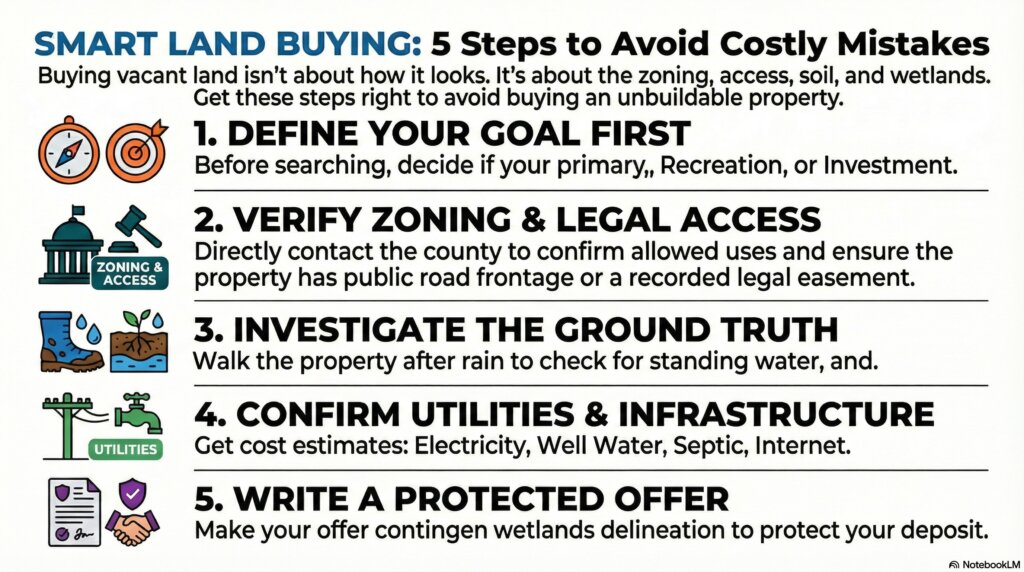
The Northeast Florida land buying process
Step 1, Decide the end use first
Before you look at lots, decide what you are buying it for:
- Primary home
- Mobile or manufactured home
- Mini farm and animals
- Recreation, hunting, weekend use
- Long term hold
Your end use controls zoning, septic feasibility, wetlands setbacks, and even financing options.
If the land cannot legally be used the way you intend, it is not a deal.
Step 2, Confirm zoning and what the county allows
Do not rely on the listing description. Confirm zoning with the county.
Check for:
- Allowed uses
- Minimum lot size
- Setbacks
- Rules for mobile or manufactured homes
- Agricultural allowances
If you want to do anything outside the usual single family home, confirm it up front.
Step 3, Verify legal access
This is one of the biggest deal killers in rural Northeast Florida.
You need:
- Public road frontage, or
- A recorded legal easement
What does not count:
- We have always driven through there
- My neighbor said it is fine
- There is a trail, so it must be legal
No legal access usually means no financing, permit issues, and tough resale.
Step 4, Walk the land in person
You cannot buy rural land from your phone.
When you walk it, look for:
- Standing water and low areas
- Ditches and drainage patterns
- Soft spots that will stay wet in rainy season
- Old trash piles, burn pits, debris
- Neighboring uses like hunting, farming, industrial property
If you can, walk it after heavy rain. Florida land changes fast.
Step 5, Septic and soil, the real buildability test
In most rural areas, septic is the make or break.
You need to know:
- Will the soil support septic
- Is the lot large enough for septic and well setbacks
- Are there flood or wet areas limiting where a drain field can go
If septic does not work, the land is not buildable for residential use, period.
Step 6, Wetlands survey, expensive but worth it
Wetlands are common across Northeast Florida. Land can look dry and still be wetlands regulated.
A wetlands survey or wetlands delineation can be pricey, but it is well worth it because it tells you:
- What parts of the property are restricted
- Where you can realistically build
- Where you cannot clear or place fill
- What will trigger permitting issues later
Skipping this is how people buy land and find out later they cannot use it the way they planned.
Step 7, Utilities and real infrastructure costs
Rural land often means private utilities. Confirm these early:
- Electric availability and cost to bring it to the build site
- Internet options and cell service
- Well feasibility
- Septic feasibility
Long runs for power or poor access for crews can change the budget quickly.
Step 8, Cleared land versus raw wooded land
Both can be good, but they are not the same.
Cleared land:
- Faster to build
- Lower upfront risk
- Often easier financing
- Still needs driveway, grading, utilities
Raw wooded land:
- Cheaper upfront
- More privacy
- Clearing costs and timelines
- More unknowns with wetlands and soil
Clearing land does not guarantee buildability. Septic and wetlands still control the outcome.
Step 9, Survey and title work
Do not trust fences or old markings.
Get a survey to confirm:
- Boundaries
- Easements
- Encroachments
- Buildable area
Then have title verify:
- Clear ownership
- No liens
- No hidden restrictions
- Access is insurable
Title insurance is not optional on land.
Step 10, Write a smart offer with the right contingencies
Land contracts need strong protections.
Common contingencies I recommend for buyers:
- Survey approval
- Title and access confirmation
- Zoning confirmation for intended use
- Septic feasibility or soil test results
- Wetlands survey results
- Acceptable utility and clearing costs
Do not rush land. Emotional offers on land are how buyers get burned.
Tips and tricks that save buyers money and headaches
Walk it twice
Walk it once for overall feel. Walk it again looking only for water, drainage, and low spots. Those are the long term problems.
Visit at different times
A quiet road at noon can be a hunting road at sunrise. A calm neighbor during the week can be loud on weekends.
Price the driveway early
Driveways on rural lots can be a major cost, especially if you need fill, culverts, or a long run from the road.
Do not assume dirt equals good soil
On the land I visited, we talked about how bringing in fill dirt often means bleach white sand with no organic material. It might level the site, but it does not grow grass well and can create new issues. Good planning beats dumping dirt.
Respect site work
After trying equipment myself, I have a bigger appreciation for grading and clearing. It is not just pushing dirt around. It is planning drainage, smoothing high points into low points, and doing it in the right order.
The simple rule I want every land buyer to remember
Good land in Northeast Florida is not about how it looks.
It is about:
- Zoning
- Legal access
- Septic and soil
- Wetlands
- Utility costs
- Cost to improve
Get those right and land can be a great buy. Skip them and it can become an expensive mistake.
Want my buyer handout
If you are thinking about buying land in Northeast Florida, I have a simple buyer guide you can use as a checklist while you shop.
Reply or contact me and I will send it over.
Contact Us
We would love to hear from you! Please fill out this form and we will get in touch with you shortly.