Checking Abandoned Houses in Lawtey, FL: Driving for Dollars, Crawlspaces, and Teardown Realities
1. The Daily Routine: Why Driving for Dollars Still Beats Desk Research in Rural Florida
Real estate investing is rarely about sitting in an air-conditioned office staring at polished MLS listings on a dual-monitor computer setup.
When you want to find genuinely distressed properties, discover motivated sellers before anyone else knows they want to sell, and solve complex real estate problems, you have to get out of the office and get your boots on the ground.
On a bright morning in early February, I decided to take a scouting trip outside my primary stomping grounds of Clay and Duval counties. I pointed my truck southwest and drove down U.S. Highway 301 into Bradford County, pulling into the historic rural community of Lawtey, Florida.
Lawtey is a quiet, tight-knit town of roughly seven hundred residents, recognized historically as the oldest incorporated municipality in Bradford County. As you drive off the main commercial highway corridor and into the residential side streets, the neighborhood landscape shifts dramatically: - You will see meticulously kept rural homesteads with pristine white picket fences, manicured lawns, and blooming azalea bushes. - Then, directly across the narrow asphalt street or two lots down, you encounter a long-abandoned cottage with sagging rooflines, shattered windowpanes, waist-high weeds, and rotted porches.
This dramatic contrast is the heart of off-market real estate discovery.
Most novice investors rely entirely on automated online scrapers or public foreclosure lists that every investor in Northeast Florida already has access to. But in rural Florida municipalities like Lawtey, Hampton, and Brooker, distressed homes rarely show up on traditional online auction portals until years of neglect have already occurred.
Driving for dollars allows you to observe physical distress in real time: roof tarps shredding in the wind, mail overflowing from bent aluminum rural mailboxes, missing electric meters, and overgrown yards. By physically observing these conditions firsthand, you can step in to help an owner resolve a lingering headache before the city or county initiates aggressive code enforcement fines or tax deed sales.
2. The Investor Tech Stack: PropStream, Skip Tracing, and Mobile Deal Analysis
While driving the backroads of Bradford County, I rely on a streamlined mobile tech stack that allows me to analyze parcels from the driver seat of my truck.
In the video walkthrough, I open up PropStream on my mobile phone.
PropStream is a specialized real estate data platform that costs approximately ninety-nine dollars per month. For active field investors, that monthly subscription pays for itself on a single transaction:
- Real-Time Parcel Identification
- As I cruise down the streets of Lawtey at fifteen miles per hour, I spot an interesting property. I pull over safely to the curb, open the app, and tap directly on the digital parcel boundary displayed on the satellite map:
- The app immediately queries public municipal records, county property appraiser data, and nationwide deed registries.
- It displays the recorded property owner of record, the mailing address where property tax bills are sent, and whether the home is owner-occupied or absentee-owned.
- It reveals historical sales transactions, open mortgage balances, estimated remaining equity, and whether any involuntary liens or lis pendens foreclosure notices have been recorded.
- On-Site Skip Tracing
- If a property appears completely vacant and distressed, the next step is finding out how to contact the owner:
- PropStream and similar investor databases feature integrated skip-tracing engines.
- With a single tap, the platform searches public credit headers, utility connection histories, and consumer databases to generate potential phone numbers and verified email addresses for the owner or their immediate family members.
- If the owner has passed away, skip tracing frequently reveals the names of surviving adult children who may have inherited the property without realizing it has fallen into severe disrepair.
- TCPA Compliance and Ethical Outreach
- Using modern technology to locate property owners comes with significant legal and ethical responsibilities:
- Outreach must comply fully with the Telephone Consumer Protection Act (47 U.S.C. Section 227) and federal Do-Not-Call regulations.
- We never use automated robodialers or deceptive marketing scripts.
- When I reach out to an absentee owner, the conversation is direct, respectful, and transparent: 'Hello, my name is Chris Moore. I was driving through Lawtey today and noticed your family property on the corner. It looks like it has been vacant for a while, and I wanted to see if you have any interest in receiving a fair, as-is cash offer without making any repairs.'
Many owners feel an overwhelming sense of relief when an experienced local buyer reaches out, because they have been worrying about the property for months but had no idea how to sell a home in rough shape.
3. Walking House Number One: The 800-Square-Foot Lawtey Cottage on a Sliver Lot
Cruising past a local city park and an established neighborhood church, I spotted my first target of the day.
It was a tiny, single-story wood frame cottage sitting on what can only be described as a sliver of land.
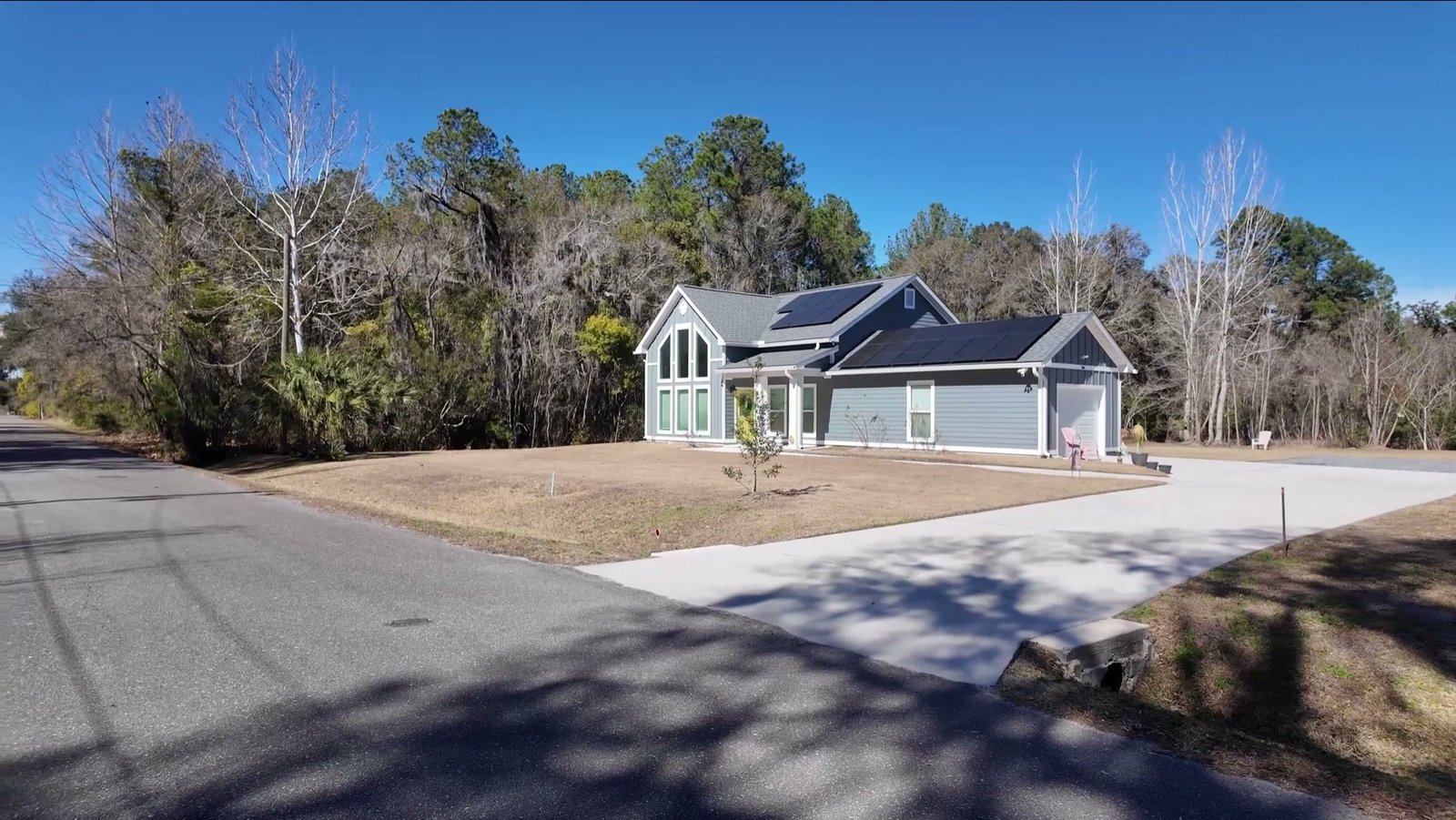
The exterior view of the first target property in Lawtey, Florida. A modest 800-square-foot cottage sitting on an undersized parcel, showing roof damage and exterior weathering.
- Property Dimensions and Parcel Layout
- Pulling up the Bradford County Property Appraiser parcel records in PropStream, the exact property specifications appeared:
- Living Area: Approximately 800 square feet of heated living space.
- Configuration: Two bedrooms and one full bathroom.
- Construction Type: Conventional wood-frame siding over an off-grade pier-and-beam crawlspace foundation, built in the mid-twentieth century.
- Lot Dimensions: A remarkably narrow, irregular residential lot that offered virtually no side yard setbacks.
- The Neighboring Contrast
- Directly across the street from this distressed cottage was a stunning example of rural pride of ownership. The home across the street featured fresh exterior paint, clean architectural shingles, well-maintained perimeter fencing, and a manicured yard.
This stark contrast told me two critical things: - First, the neighborhood itself was stable, peaceful, and desirable for local working families. - Second, this specific abandoned house was an eyesore holding back the street, making it an ideal candidate for professional investor intervention.
- The Adjacent Parcel Opportunity
- Looking closely at the digital GIS property map, I noticed something fascinating:
- Directly behind the cottage was an overgrown, vacant residential parcel owned by a separate party.
- Adjacent to both parcels on the street corner was a third vacant parcel, also held by a different owner.
- In total, there were three contiguous parcels: two vacant land lots and one lot containing this tiny cottage.
In real estate, when you encounter multiple contiguous undersized or non-conforming parcels, your mind immediately goes to parcel assemblage. If an investor can purchase the distressed cottage and simultaneously negotiate cash purchases on the adjoining vacant parcels, you can assemble a substantial residential tract with ample road frontage, creating immense long-term value.
4. Inside the Spider Paradise: Mudstorms, Ceiling Decay, and Missing Insulation
Stepping up to the front entrance of the cottage, the true extent of interior abandonment became apparent.
The front door was unsecured. Pushing it open slowly, I stepped into what I can only describe as a spider paradise.
Interior walkthrough of the living room and hallway. Heavy spiderwebs covered the ceilings, water had penetrated the ceiling drywall, and subfloors were severely weakened.
- Biological Takeover and Severe Arachnid Activity
- When a house sits unoccupied in rural Florida without electricity, climate control, or human presence, nature reclaims the interior with astonishing speed:
- Thick, dense spiderwebs blanketed every doorframe, corner junction, and ceiling light fixture. Walking through required waving a flashlight ahead to avoid stepping face-first into massive orb-weaver webs.
- Broken window glass was scattered across the living room floor, allowing outdoor humidity, rain, and insects to circulate freely through the structure.
- Water Damage, Mud Staining, and Mold Growth
- Looking closely at the interior walls and doors, it looked as though a severe mudstorm had swept through the residence:
- Heavy dark silt lines and dried mud splatters coated the lower thirty inches of the interior doors and drywall, indicating that floodwaters had previously risen above the floorboards during a major storm or hurricane.
- The acoustic popcorn ceilings were heavily stained with dark brown water rings. In several areas, moisture absorption had caused the popcorn texture to delaminate, exposing sagging gypsum wallboard underneath.
- Active surface mold was visible along the ceiling corners and closet interiors, fueled by the persistent 85% relative humidity common to unconditioned North Florida summers.
- Non-Existent Thermal Insulation
- Peeking through an open access hole in the ceiling drywall, I examined the roof framing:
- Like many rural Florida cottages constructed before the implementation of modern energy codes in the late 1970s, the home had zero batt or blown-in insulation in the attic rafters.
- The exterior 2x4 stud walls were completely uninsulated. In summer months, an uninsulated wood-frame cottage functions like a convection oven, placing extreme loads on any air conditioning system.
- Spongy Subfloors and Structural Weakness
- As I walked toward the bedrooms, the floorboards flexed significantly beneath my work boots:
- In off-grade homes, chronic roof leaks and standing floodwater cause standard 1/2-inch plywood or tongue-and-groove subflooring to rot and delaminate.
- Stepping directly between floor joists on rotted subflooring is an easy way to plunge a leg through the floor into the crawlspace. I had to step carefully along visible nail lines to keep my weight anchored directly over the supporting joists.
5. Crawlspace Forensics: Off-Grade Foundations, Termites, and Storm Flooding
Rather than guessing at the structural integrity of the home from the inside, I decided to conduct an inspection of the foundation.
Because the crawlspace opening was tight and full of cobwebs, I attached my camera to a long selfie stick, lowered it through an access point near the foundation perimeter, and swept the lens underneath the structure.
Under-house foundation inspection utilizing a selfie stick camera mount. Inspecting crawlspace piers, wooden girders, and ductwork without crawling into active pest harborages.
- Anatomy of an Off-Grade Florida Foundation
- In Northeast Florida, older homes were frequently built off-grade rather than on poured concrete slabs:
- The structure rests on perimeter concrete masonry unit (CMU) piers or poured concrete footers spaced roughly six to eight feet apart.
- Heavy timber sills and girders span across the piers, supporting 2x8 or 2x10 floor joists on sixteen-inch centers.
- While off-grade construction provides easy access to plumbing pipes and elevates the living quarters above minor surface runoff, it creates serious vulnerabilities if the crawlspace is not properly maintained.
- Wood-Destroying Organisms and Moisture Trapping
- Inspecting the framing through the camera monitor revealed several key structural issues:
- Standing Ground Moisture: The sandy ground beneath the home lacked a 6-mil polyethylene vapor barrier. Moisture evaporating from the high Florida water table was continually absorbing into the unsealed subfloor framing.
- Fungal Wood Rot: The bottom edges of several perimeter floor joists exhibited brown cubical rot (commonly referred to as dry rot), where cellulose-eating wood decay fungi had compromised the structural strength of the lumber.
- Termite Exposure: Northeast Florida is ground zero for subterranean termites (Reticulitermes flavipes). When wooden framing sits close to moist soil without chemical termite soil barriers or metal termite shields atop the masonry piers, termites construct mud shelter tubes directly into the subfloor framing.
- The Unexpected HVAC Discovery
- Amidst the foundation decay, the camera swept across a surprising asset:
- Mounted on a concrete pad adjacent to the crawlspace was a relatively modern exterior split-system heat pump condenser, accompanied by clean insulated refrigerant lines.
- Looking at the electrical disconnect box and newer ductwork runs under the subfloor, it was clear that someone had invested significant capital to upgrade the HVAC system several years earlier.
- Unfortunately, after the mechanical upgrades were completed, an unexpected storm or flood event occurred, water infiltrated the home, and the owner abandoned the property before finishing the renovation.
In real estate investing, finding high-value mechanical components like a functional HVAC compressor can save thousands of dollars during rehabilitation, provided the equipment has not been flooded or vandalized.
6. The Art of Land Assemblage: Turning Sliver Lots into Buildable Parcels
Standing outside the 800-square-foot cottage and looking at the adjoining overgrown terrain, the strategic real estate play became obvious: parcel assemblage.
- The Problem with Non-Conforming Sliver Lots
- In rural municipalities like Lawtey, many historical residential lots are legally classified as legal non-conforming parcels:
- Decades ago, small lots measuring fifty feet wide by one hundred feet deep (5,000 square feet) were platted without regard to modern zoning ordinances.
- Today, under Bradford County Land Development Regulations and municipal building codes, single-family residential zoning typically requires a minimum lot size of 10,000 to 20,000 square feet, along with minimum road frontage of seventy-five to one hundred feet.
- If a standalone cottage on a 5,000-square-foot sliver lot burns down or is demolished, the owner may struggle to obtain a new residential building permit because the lot fails to meet current setback and septic tank separation requirements.
- The Power of Contiguous Parcel Assemblage
- Look at how the economics transform when you combine adjoining properties:
| Parcel Identifier | Current Status | Estimated Standalone Value | Assembled Value Contribution |
|---|---|---|---|
| Parcel A (Cottage Lot) | 800 sq ft Distressed House on 0.12 Acres | $25,000 - $35,000 (As-Is) | $45,000 (Part of Tract) |
| Parcel B (Rear Lot) | Overgrown Vacant Land (0.15 Acres) | $10,000 - $14,000 | $20,000 (Expands Depth) |
| Parcel C (Corner Lot) | Vacant Corner Land (0.18 Acres) | $12,000 - $16,000 | $25,000 (Adds Corner Access) |
| Combined Assembled Tract | 0.45 Acres with Full Corner Frontage | $47,000 - $65,000 (Raw) | $90,000 - $115,000 (Buildable) |
- The Administrative Process for Lot Combination
- To execute a successful lot assemblage in Bradford County, Florida:
- Title Verification: Run full forty-year title searches through a licensed Florida title agency to ensure each parcel is free of unrecorded municipal code liens, mortgage encumbrances, or delinquent county tax certificates.
- Boundary Survey: Hire a Florida licensed professional surveyor and mapper (PSM) to perform a boundary and topographic survey, staking the exterior perimeter of the combined tract.
- Lot Consolidation Application: Submit a formal Petition for Parcel Combination to the Bradford County Property Appraiser and local planning department. Once approved, the county assigns a single unified parcel identification number (PIN).
- Rezoning and Permitting: The newly consolidated tract easily satisfies zoning setbacks, providing sufficient acreage for a modern replacement home, two-car garage, and a properly engineered private septic drainfield.
7. Walking House Number Two: The Mysterious Exorcist House and Safety Limits
After finishing my inspection of the cottage, I drove two streets over to investigate another flagged property on my PropStream map.
This second property was larger, sitting on an expansive residential lot surrounded by mature oak trees. Property records indicated it had last traded hands around 2006, after which public records went completely quiet.
Walking up the overgrown driveway, I approached a set of sturdy concrete entrance steps. But the moment I stepped across the threshold, my instincts screamed caution.
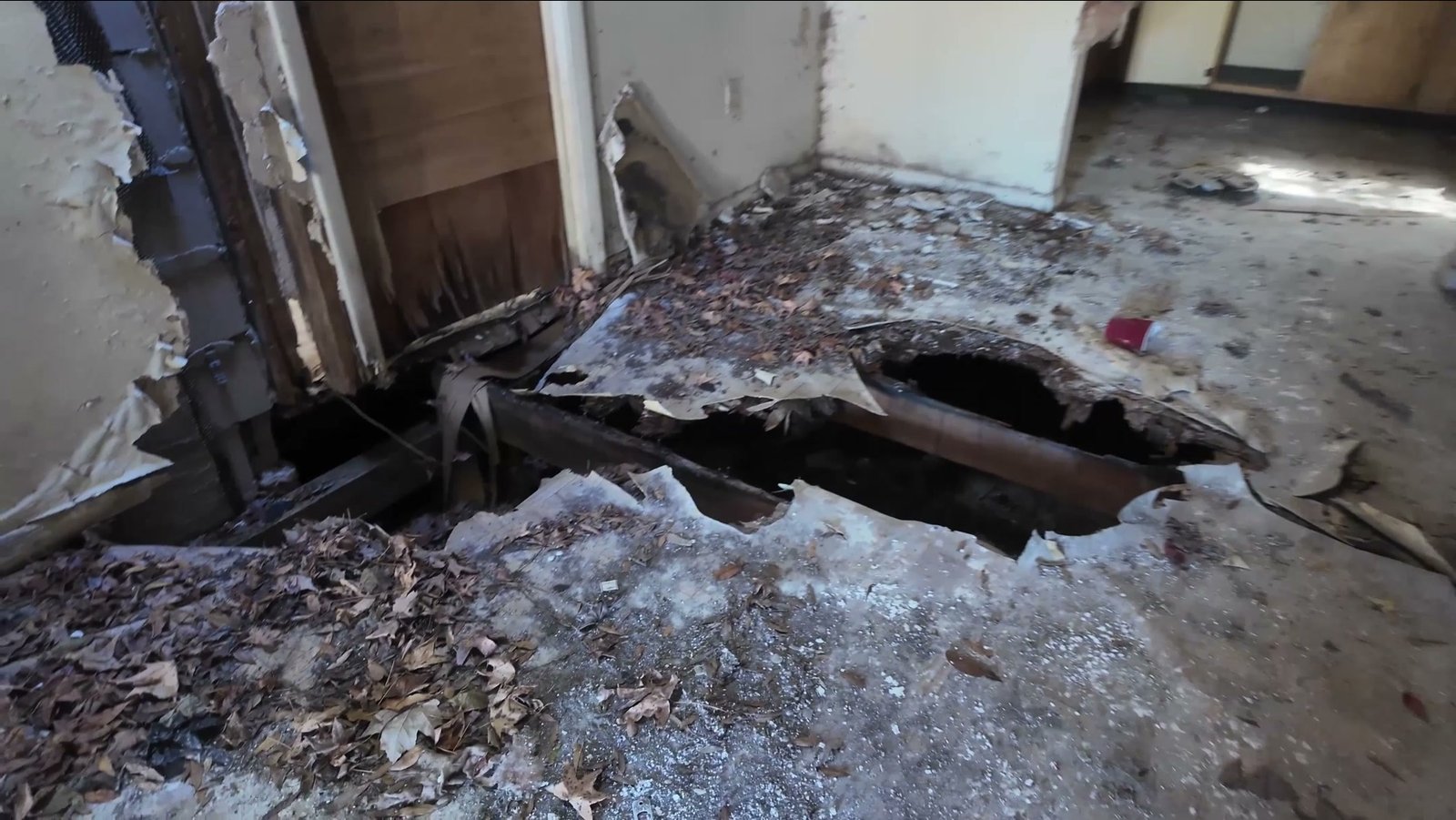
Inside the second abandoned property in Lawtey. Structural floor collapses, scattered historical relics, and bizarre wall staining that raised immediate safety red flags.
- Catastrophic Floor Collapses
- The structural framing beneath this second home had failed completely:
- The wooden floorboards in the front hallway had disintegrated, leaving gaping holes that exposed the dirt crawlspace below.
- Stepping forward was impossible without balancing precariously on rotted joist edges that were visibly sagging under their own weight.
- Relics of an Abrupt Departure
- Scattered across the collapsing floorboards were eerie artifacts of past occupancy:
- Yellowed newspaper clippings and circulars dating back nearly two decades lay scattered across the dust.
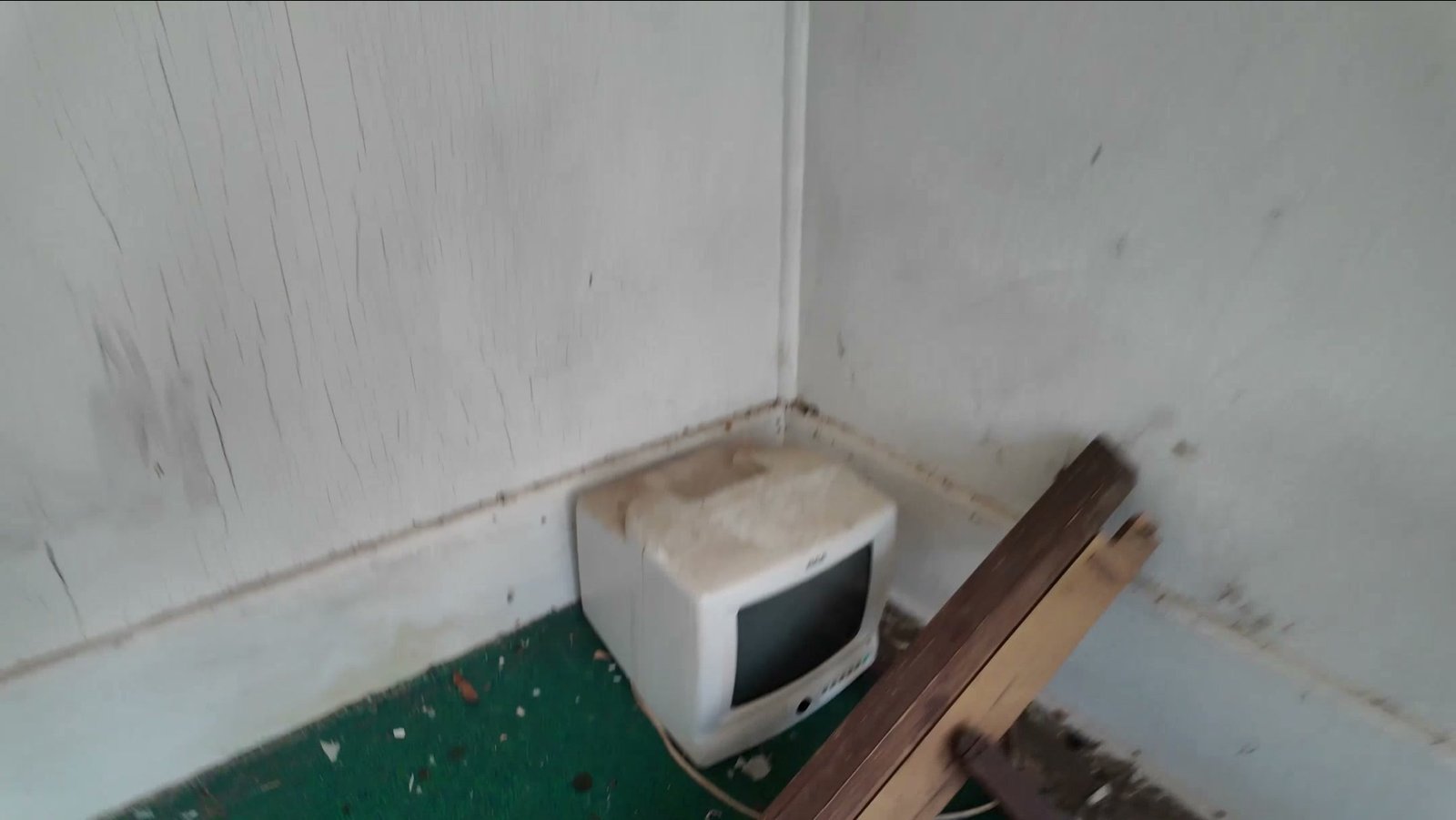
- An ancient, heavy cathode-ray tube console television sat tilted against a failing wall.
- It looked as though the occupants had vanished suddenly in 2006, leaving their possessions behind to rot in the elements.
- The Bizarre Exorcist Room
- Stepping toward the primary living room, I observed something truly unsettling:
- The walls were covered in an erratic, circular spray pattern of dark brown, dried residue that spanned the entire circumference of the room.
- It looked like someone had taken a high-pressure agricultural sprayer filled with foul liquid and sprayed the drywall from floor to ceiling. As I said in the video, it felt like walking directly onto the movie set of The Exorcist.
- To make matters creepier, someone had scrawled unsettling graffiti across the corner sheetrock: 'I got my eyes on you.'
- Professional Safety Boundaries: Knowing When to Retreat
- When you inspect distressed real estate for a living, you must establish non-negotiable safety limits:
- Your heart rate spikes for a reason. Adrenaline is a biological warning system signaling structural collapse hazards, chemical contamination, toxic black mold spore saturation, or unstable squatters.
- I noticed another detached outbuilding behind the main house. But seeing the collapsed structural framing, the hazardous flooring, and the bizarre contamination inside, I made the executive decision not to push my luck.
- This property was not a cosmetic rehab. It was not a gut renovation. This property was a definitive, unambiguous tear-down.
8. Teardown vs. Gut Rehab: How Real Estate Investors Calculate the Tipping Point
One of the most critical decisions a real estate investor must make when assessing severely neglected rural properties is determining whether to renovate the existing structure or demolish it completely.
- The Law of Diminishing Rehab Returns
- Many beginner investors fall into the trap of believing that preserving an existing structure always saves money. In reality, attempting to salvage a compromised wood-frame home can cost fifty percent more than building new:
- When structural sill plates, floor joists, subflooring, wall studs, and roof trusses are compromised by water rot and termites, you essentially have to dismantle the house stick by stick while trying to prevent it from collapsing.
- Jacking up an off-grade house to replace rotted timber sills requires specialized foundation contractors, structural engineering stamps, and significant labor expenses.
- Bringing a heavily damaged pre-1970s frame home up to current Florida Building Code standards (including 140 mph wind load ratings, hurricane tie-downs, impact windows, and energy insulation minimums) triggers mandatory modern compliance for the entire structure if renovation costs exceed 50% of the building value under local FEMA 50% rules.
- Demolition Permitting and Site Clearing Logistics
- Demolishing a residential property in Bradford County involves specific regulatory steps:
- Asbestos Notification: Under National Emission Standards for Hazardous Air Pollutants (NESHAP) and Florida Department of Environmental Protection (DEP) regulations, residential structures must be inspected for friable asbestos materials (such as vermiculite attic insulation or transite siding) prior to mechanical demolition.
- Utility Disconnect Letters: Before the Bradford County Building Department will issue a demolition permit, you must secure official disconnect verification letters from the local electric utility, natural gas or propane supplier, and municipal water authority.
- Heavy Equipment and Haul-Away: Demolishing an 800 to 1,200 square foot wood-frame house requires an excavator equipped with a hydraulic thumb, several 30-yard roll-off dumpsters, and site grading equipment. In rural Bradford County, 30-yard dumpster rentals run between $650 and $900 per haul due to disposal landfill tipping fees.
- The New Construction Alternative
- Once a dilapidated teardown is cleared and the lot is graded:
- The site retains its valuable utility connections, including an established electric drop, private well, and septic system.
- An investor or builder can place a brand-new, energy-efficient manufactured home or modern modular residence on permanent concrete footers for $80,000 to $120,000.
- The resulting property qualifies for standard FHA, VA, and conventional thirty-year mortgage financing, appealing to local retail home buyers who want modern reliability without rural renovation headaches.
9. Bradford County Real Estate Market Realities: Comps, Wells, and Septic Systems
Understanding property values in rural North Florida requires an entirely different perspective than analyzing urban subdivisions in Jacksonville or master-planned communities in Clay County.
- Bradford County Housing Market Metrics
- According to sales reporting from the Northeast Florida Association of Realtors (NEFAR) and Bradford County Property Appraiser deed records:
- Median Single-Family Sales Price: Approximately $195,000 to $225,000 for standard move-in ready single-family homes across Starke, Lawtey, and Hampton.
- Average Days on Market: Turnkey properties average between 60 and 80 days from listing to contract, reflecting a smaller local buyer pool compared to metropolitan Duval County.
- Inventory Levels: The market maintains approximately 4.5 to 5.2 months of available inventory.
- Rural Infrastructure Due Diligence: Private Wells and Septic Tanks
- In urban neighborhoods, municipal water and sewer connections are taken for granted. In rural Bradford County, independent onsite utilities dictate property viability:
- Private Potable Wells: Most homes in Lawtey draw drinking water from private shallow or deep Floridan aquifer wells. When inspecting a vacant property, the well pump, pressure tank, and water lines must be evaluated for mechanical function. Water samples should be lab-tested for coliform bacteria, high nitrates, iron, and hydrogen sulfide odors. Replacing a submerged well pump and pressure tank costs between $2,500 and $4,500.
- Septic Tank Regulations: Under Florida Department of Health Rule 64E-6 (Florida Administrative Code), onsite sewage treatment and disposal systems (OSTDS) must maintain strict horizontal setback distances from private wells (typically 75 feet) and surface water bodies.
- Failing Drainfields: If a septic tank has flooded or sat stagnant for years, drainfield soil absorption trenches frequently become biologically clogged with biomat. Installing a brand-new engineered septic tank and drainfield in Bradford County costs between $8,500 and $14,000, depending on soil percolation tests and water table elevations.
When buying distressed rural properties, an investor must factor potential septic and well replacements directly into the purchase offer to avoid catastrophic budget blowouts.
10. Itemized Contractor Scope: Gut Rehab vs. Complete Teardown and Rebuild
To understand why an experienced cash investor makes conservative offers on distressed rural properties, consider the itemized financial breakdown comparing a comprehensive gut rehabilitation against a complete teardown and site clearing for an 800-square-foot cottage in Lawtey.
| Project Scope Component | Strategy 1: Comprehensive Gut Rehab | Strategy 2: Complete Demolition & Site Clearing |
|---|---|---|
| Interior Demolition & Trash-Out | $5,500 - $7,500 (mold & debris removal) | Included in mechanical site demo |
| Structural Foundation & Joist Repair | $9,500 - $14,000 (jacking piers & timber) | $0 (structure completely removed) |
| Complete Roof Tear-Off & Framing | $8,500 - $12,500 (decking & shingles) | $0 |
| Exterior Siding, Trim & Windows | $11,000 - $16,000 (fiber cement & glass) | $0 |
| Electrical Rewiring & Service Panel | $7,500 - $10,500 (200A service upgrade) | $1,500 (disconnect & temp pole) |
| Plumbing Re-pipe & Fixtures | $6,500 - $9,500 (PEX supply & PVC drain) | $1,200 (capping & testing supply) |
| HVAC System & Ductwork Repairs | $4,500 - $7,000 (servicing heat pump) | $0 |
| Insulation, Drywall & Knockdown | $8,500 - $12,000 (R-38 attic & R-13 walls) | $0 |
| Kitchen & Bathroom Gut Renovation | $14,000 - $19,500 (cabinets, tile, tops) | $0 |
| Flooring (800 sq ft LVP) | $4,000 - $6,000 (subfloor prep & luxury vinyl) | $0 |
| Paint, Trim & Interior Doors | $5,000 - $7,500 (primer, paint & millwork) | $0 |
| Excavator Demolition & Hauling | $0 | $7,500 - $11,000 (excavation & hauling) |
| Asbestos Survey & City Demo Permits | $0 | $1,200 - $1,800 (permits & testing) |
| Well Testing & Septic Drainfield | $8,500 - $13,500 (health dept certified) | $8,500 - $13,500 (preserved for new build) |
| Total Estimated Project Cost | $93,000 - $135,500 (High Risk Rehab) | $19,900 - $29,000 (Clean Cleared Lot) |
Notice the critical insight this financial comparison reveals: spending $115,000 to rehabilitate an 800-square-foot cottage in a market where the maximum after-repair value (ARV) tops out around $150,000 leaves virtually zero profit margin.
In contrast, demolishing the unsafe structure for $25,000 leaves a clean, buildable lot with grandfathered utility access, ready for a modern modular home or parcel assemblage with adjoining lots.
11. Selling an Abandoned Rural Property As-Is: Cash Investor vs. Traditional MLS Listing
If you own an inherited, abandoned, or heavily distressed property in Lawtey or anywhere in Bradford County, you face a major dilemma: how do you sell a house that traditional banks refuse to finance?
- Why Traditional Mortgage Financing Fails on Distressed Homes
- Over eighty percent of retail home buyers purchase properties using conventional, FHA, or VA mortgage loans:
- Under Fannie Mae and Freddie Mac lending guidelines, a property must meet strict minimum property standards (MPS) to qualify for financing.
- Appraisers will instantly reject properties with active roof leaks, broken windows, spongy or missing floorboards, active mold infestations, or inoperable plumbing fixtures.
- An appraiser will not sign off on a mortgage if a home has open foundation crawlspace holes or uncertified septic tanks.
- As a result, listing a severely distressed rural property with a traditional real estate agent on the MLS usually leads to weeks of tire-kicker showings, failed buyer loan applications, and frustrating inspection cancellations.
- The Direct As-Is Cash Solution
- When you work directly with We Buy Any House In Florida, we bypass traditional banking red tape entirely:
| Transaction Feature | Traditional Real Estate Agent Listing | Direct Sale to We Buy Any House In Florida |
|---|---|---|
| Upfront Repair Requirements | Thousands spent fixing roofs, floors & mold | Exactly $0. We buy in 100% as-is condition |
| Cleaning & Belonging Cleanout | Must remove all spiderwebs, trash & furniture | Leave whatever you do not want behind |
| Bank Financing Contingencies | Subject to buyer loan approval & appraisal | Zero financing contingencies (100% Cash) |
| Realtor Broker Commissions | 5% to 6% deducted from your sale proceeds | 0% (No agent commissions or broker fees) |
| Closing Costs & Title Fees | Seller pays 2% to 4% in closing fees | We pay 100% of standard closing costs |
| Municipal Code Violations | Seller must resolve all citations & liens | We assume all violations and city liens |
| Speed to Cash Closing | 60 to 90+ days of delays and inspections | Fast closing in as little as 14 business days |
Whether your property is plagued by rotted crawlspaces, massive spider colonies, structural water damage, or eerie teardown conditions like the Exorcist house, you never have to pick up a hammer, clean out unwanted belongings, or spend out-of-pocket money.
12. Frequently Asked Questions About Distressed and Abandoned Homes in Bradford County
Here are answers to common questions homeowners and heirs ask when navigating distressed or abandoned real estate in rural Northeast Florida:
- Can I sell an abandoned house in Bradford County if I live out of state?
- Yes. We routinely assist out-of-state heirs and property owners who live in Georgia, New York, North Carolina, or across the country. You do not need to travel back to Lawtey or Starke. We coordinate all purchase paperwork electronically via secure e-signatures and arrange for mobile notary closings directly at your home or office. Sale proceeds are wired securely to your bank account on closing day.
- What happens if an abandoned property has delinquent property taxes or county liens?
- When you sell directly to We Buy Any House In Florida, our closing title company conducts a comprehensive title examination. Any back property taxes, county tax certificates, or municipal code compliance liens are settled directly from sale proceeds at the closing table. You never have to bring cash out of pocket to clear past-due taxes.
- Will you still buy the property if the septic tank is completely failed?
- Yes. We buy properties with failed septic tanks, collapsed drainfields, condemned wells, and compromised electrical systems. Because we purchase with private cash capital, we do not require bank septic inspections or health department operating permits prior to closing.
- What if there are unwanted personal items, trash, or biohazards left inside?
- Take whatever personal mementos, family photographs, or valuable keepsakes you wish to preserve, and leave everything else behind. We handle the entire trash-out, dumpster hauling, and property cleanout process at zero expense to you.
- How do I get a cash offer for my Lawtey or Bradford County property?
- Getting started is simple. Give our local office a call at (904) 606-9163 or visit https://www.webuyanyhouseinflorida.com/get-a-cash-offer-today/ to provide your property address. We will analyze your parcel records, schedule a quick walkthrough, and present you with a fair, no-obligation as-is cash offer within twenty-four hours.
This guide is provided for educational purposes and does not constitute legal, tax, or engineering advice. Consult qualified professionals for specific legal and structural matters.
Own an Abandoned or Distressed Florida House?
Skip the repairs, ignore the cleanup, and avoid traditional lender rejections. We buy properties in as-is condition across Bradford, Clay, Duval, and Putnam counties with zero commissions or fees.
Get Your Free As-Is Cash Offer